

Beschreibung
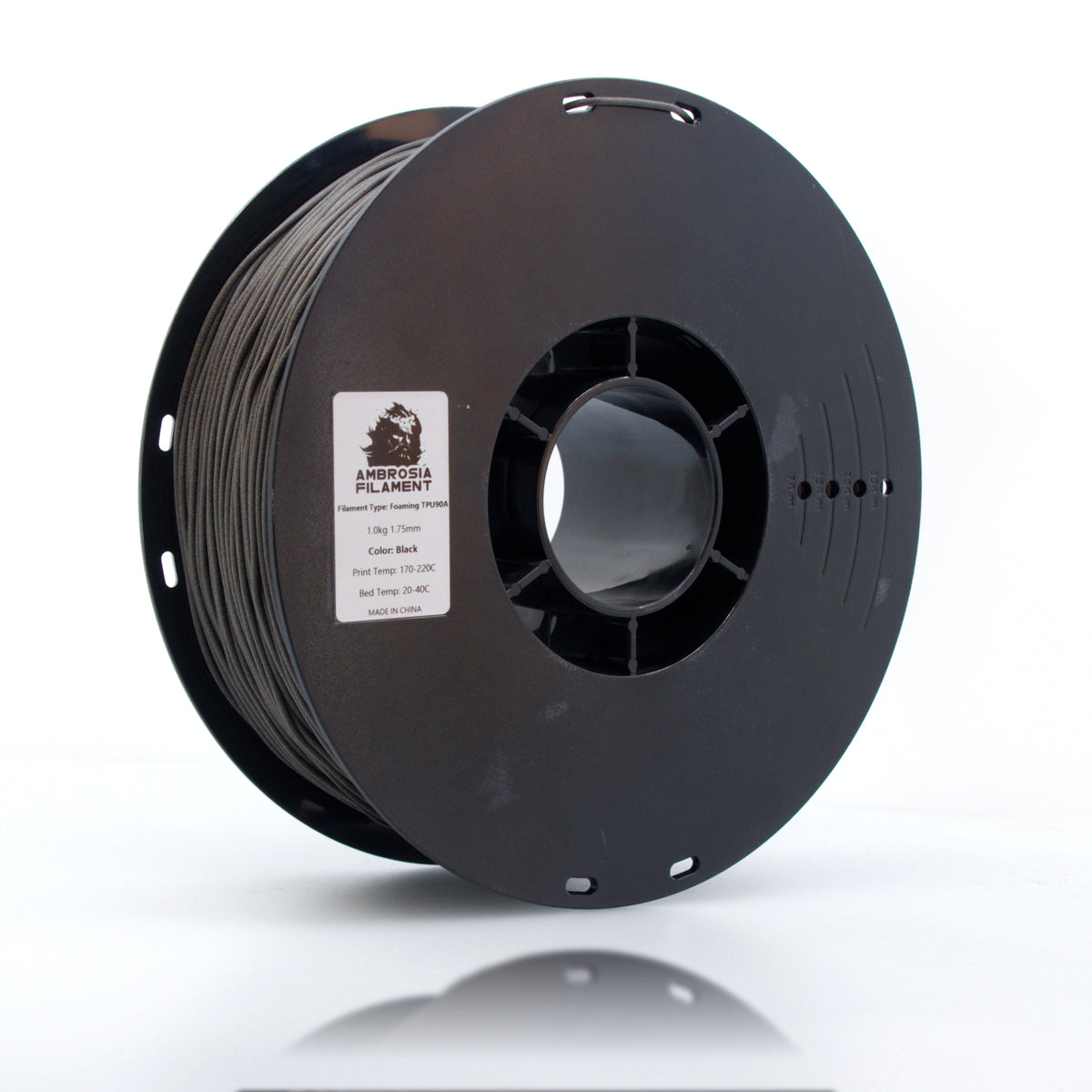
Ambrosia Filament's line of Foaming TPU (Thermoplastic Polyurethane) is a specially formulated flexible filament that expands during printing to create lightweight, soft, and cushioned parts. Offering excellent flexibility, impact absorption, and a unique foamed structure, this material is ideal for both industrial and hobby applications where comfort, weight reduction, and elasticity matter.
Manufactured to a tighter-than-standard diameter tolerance (+/- 0.03mm), you'll experience consistent extrusion throughout the spool. Unlike traditional TPU, Foaming TPU contains an active foaming agent that expands when heated, allowing you to adjust the density and softness of your printed parts through print temperature and flow settings.
Feed your Printer the Filament of the Gods.
Foaming TPU is a fantastic printing material when you need the flexibility and durability of traditional TPU, but with added softness, cushioning, and reduced weight.
During extrusion, the material expands to create a cellular structure within the printed plastic. By adjusting your printing temperature and flow ratio, you can control the degree of foaming to produce firmer, denser parts or softer, more lightweight components.
This makes Foaming TPU especially useful for applications such as footwear and insoles, wearable accessories, protective padding, vibration dampeners, shock-absorbing components, RC aircraft accessories, flexible grips, and other projects where conventional TPU may be too dense or firm.
Key Benefits of Foaming TPU:
-
Lightweight Construction: Active foaming creates a lower-density printed structure, reducing weight compared with conventional TPU.
-
Adjustable Softness: Tune printing temperature and flow settings to adjust the degree of expansion, softness, and density of your finished parts.
-
Excellent Cushioning: The foamed structure helps absorb impacts and vibrations, making it ideal for padding, protective components, and shock-absorbing applications.
-
Flexible and Elastic: Maintains TPU's characteristic flexibility and ability to deform and recover, with properties dependent on the degree of foaming.
-
Versatile Applications: Great for footwear, insoles, wearable components, RC aircraft accessories, flexible joints, and lightweight functional parts.
-
Customizable Print Characteristics: Produce different levels of firmness and cushioning from the same filament by adjusting printing parameters.
Check out our other lines of Ambrosia Filament!
|
ASA |
ASA-CF |
ASA Sparkle |
ASA Dolos |
ABS+ |
PETG |
PLA |
|
PC-ABS |
PC-CF |
TPU |
ABS Matte |
ASA-GF |
PLA-SILK |
|
|
PPS-CF |
PET-GF | Foaming TPU | PCTG |
Ambrosia Filament's line of Foaming TPU (Thermoplastic Polyurethane) is a specially formulated flexible filament that expands during printing to create lightweight, soft, and cushioned parts. Offering excellent flexibility, impact absorption, and a unique foamed structure, this material is ideal for both industrial and hobby applications where comfort, weight reduction, and elasticity matter.
Manufactured to a tighter-than-standard diameter tolerance (+/- 0.03mm), you'll experience consistent extrusion throughout the spool. Unlike traditional TPU, Foaming TPU contains an active foaming agent that expands when heated, allowing you to adjust the density and softness of your printed parts through print temperature and flow settings.
Feed your Printer the Filament of the Gods.
Foaming TPU is a fantastic printing material when you need the flexibility and durability of traditional TPU, but with added softness, cushioning, and reduced weight.
During extrusion, the material expands to create a cellular structure within the printed plastic. By adjusting your printing temperature and flow ratio, you can control the degree of foaming to produce firmer, denser parts or softer, more lightweight components.
This makes Foaming TPU especially useful for applications such as footwear and insoles, wearable accessories, protective padding, vibration dampeners, shock-absorbing components, RC aircraft accessories, flexible grips, and other projects where conventional TPU may be too dense or firm.
Key Benefits of Foaming TPU:
-
Lightweight Construction: Active foaming creates a lower-density printed structure, reducing weight compared with conventional TPU.
-
Adjustable Softness: Tune printing temperature and flow settings to adjust the degree of expansion, softness, and density of your finished parts.
-
Excellent Cushioning: The foamed structure helps absorb impacts and vibrations, making it ideal for padding, protective components, and shock-absorbing applications.
-
Flexible and Elastic: Maintains TPU's characteristic flexibility and ability to deform and recover, with properties dependent on the degree of foaming.
-
Versatile Applications: Great for footwear, insoles, wearable components, RC aircraft accessories, flexible joints, and lightweight functional parts.
-
Customizable Print Characteristics: Produce different levels of firmness and cushioning from the same filament by adjusting printing parameters.
Packaging and Specifications
-
Arrives in a cardboard box, with filament wound on a cardboard spool, vacuum sealed with a desiccant bag.
-
Diameter: 1.75mm (+/-0.03mm)
-
Filament Net Weight: TBD
-
Spool Weight: 130g (confirm for this product)
The glue holding the filament spool together is rated for an environment of 70°C (158°F). If using a filament dryer or placing the spool in an environment exceeding this temperature, we recommend printing a spool clip.
Ambrosia Filament's Recommended Print Settings for Foaming TPU
| Attribute | Accepted Value(s) [Our Recommended Value] |
|---|---|
| Extruder Temperature | TBD based on foaming characteristics |
| Heated Bed | TBD |
| Build Surface | Textured PEI or other suitable surface with separation layer |
| Cooling Fan | TBD based on desired foaming and print quality |
| Environmental Temperature | Ambient or controlled environment; TBD |
| Flow Ratio | 0.60–0.80 [0.80 starting point] |
| Printing Speed | TBD |
Important Printing Notes:
Foaming TPU behaves differently from conventional TPU. Because the material expands during extrusion, standard TPU settings may produce oversized extrusion lines, excessive material buildup, or inconsistent print dimensions.
For best results, we recommend starting with a suitable TPU profile and adjusting the flow ratio and extrusion temperature to achieve your desired degree of foaming.
Higher extrusion temperatures can promote greater foaming, while reduced flow ratios help compensate for expansion. The resulting softness, density, and dimensional accuracy will depend on your printer, settings, and part geometry.
A direct-drive extruder with a short, well-constrained filament path is recommended for reliable feeding. As with other flexible materials, slower print speeds and careful retraction tuning may improve results.
Filament can absorb moisture easily. To prevent moisture absorption and contamination, the packing of filament should be kept sealed and in an airtight container with desiccant.